Tag Archives: diy

Air mortar pt4 GORE BLAST

Air mortar pt4 GORE BLAST

Continued from the experiments here; http://isdrab.com/2012/09/01/air-mortar-pt3/

Not quite ready for “real” pyro, but feeling pretty good about the compressed air rig and battery operated valve, I decided to apply it towards an effect I wanted for Drab Future.

Here is what I was looking at as reference. Specifically I wanted to use it for a blood squib effect and having someone lose an arm. I knew it could explode so it was a matter of seeing how much of a blast it produces, if it is safe for an actor to wear and exactly how it looks/works. I’d never strap it to someone else before testing it on myself first, so here goes;

I’m gonna need a lot of blood…
Gallon of delicious fake blood restocked.


Vacuum former; part 1

Years ago I had a freelance gig building a proof of concept model for a type of modular part. I whipped together a rapid prototyping machine out of a drawer, a bit of wood and aluminum scrap, my shop vac, some binder clips, and oven.

Not a bad test pull for hacking together a vacuum former from scrap on hand.

It was crude, cost almost nothing to make and worked pretty well. I ended up making a bunch of things with it, because it was fast and easy.

bianca armor

The lightweight armor for this puppet was pulled from solid resin prototypes in the course of an evening.

Eventually when the oven was replaced, I was asked not to put plastic in the new one anymore, since I had no immediate need for fast hollow plastic forms, I boxed it all up and put it in storage.


Returning to the former

Recently I found reasons to to develop a larger one, partly for some of the larger Drab Future models and partly for a friend, so I brought out the old machine and hacked apart an old space heater I’d had lying around along with some more scrap materials to try it out. Think of it as a ‘proof of concept’ basically to see what I ccould do in a night to get this up and running.

This looks like the heater;
http://www.infraredheaters.com/mcm.html
heater

Wired the whole thing into some frame made from aluminum.
Untitled

And this is the arrangment with the new frame and binder clips
Untitled

Once the plastic starts to droop, lift it off and drop it onto the platen and flip on the vacuum.
Untitled

Things to look out for; As you can see the heat is a bit uneven, so I need to build a better insulated box and better distribute the heat over the entire surface and I don’t think the shop vac I was using had a very good seal.
Untitled

It’d be nice to get this mini machine working, but it is hardly a priotity. I’m going to need something better, bigger, and more modular, but I’ll keep it around and use some scraps to fix it up.

Design Goals

  • Armor factory, want to be able to quickly form wearable suits of armor, estimate a maximum 2×2 foot max size needed.
  • Small foot print, Not a lot of room in the studio, so looking at an overhead heater, and storage space below the table.
  • Work surface as multi-use work bench table, large forming surface, want platen for 2” square frame and interchangeable for 1” squares as well as single hole for mold rubber evacuator.
  • Started drawing up some designs, based on a few ideas I’ve seen online;

    Untitled
    Untitled

    Construction

    So I’ve begun by making the platen from parts I had on hand and looking at the size/shape of the work surface to see what will be useful and comfortable, mostly just holding up poarts to visualize and get the feel for it at this stage.

    Untitled

    I opted for 2×2 because that seems to be a standard size of available plastic sheet, and should allow me enough working space for even large parts of armor.

    Untitled

    This is about as far as I’ve gotten so far, and will need to consider picking up parts and materials to go any further.

    Parts List

    Looking at this list the estimate is about 300$ in parts, I’m hoping to make that less by being inventive…

  • ½-¾ MDF for table construction
  • ¼-⅜ Hardibacker for oven box
  • wood/metal support to elevate oven box
  • wood/metal frame to hold plastic
  • frame hinges
  • tracks for frame
  • clamps from track to frame
  • Heating element
  • Source of Suction

  • Expendable Materials

    24×24 sheets of ABS and/or HIPS at 1-1.5mm thickness
    Currently it appears that they run about 8-10$ a sheet, not too bad, but considering the ammount of test pulls I need to do… yeah.


    Heating element

  • Quartz patio heater
  • 50$ (might need two)
    26.5 x 5.2 x 14.2 inches

    http://www.amazon.com/Ceiling-Mounted-Workshop-Heater-Halogen-Light/dp/B002VMKCWQ/ref=cm_cmu_pg__header

  • Modular Heater Kit and protoform plans
  • $235 (220 volt)

    http://www.build-stuff.com/FastHeatFlyer.htm

    Vacuum/suction source
    Looks like there are two options here, need to look at shopvac vs pump/tank. Shopvacs seem to be sorted by two factors, size and horsepower. I don’t need a very large one, but one that has a large force behind it. The advantage of a Ahopvac is that I won’t need to spend more time/money on plumbing and filters, and I’ll have an new additional tool for the shop. The downside is that it’ll never create as much force as a smaller pump/tank arrangment, and wouldn’t be able to pull double-duty de-gassing mold rubber.

  • Shop vac
  • I’m unsure what constitutes “enough” suction in terms of hp, it’d depend on the gauge of the plastic and other factors, but I doubt a shopvac could ever give “too much”.

    3hp 44$
    4.5 66$
    5hp 80$
    6hp 100$

  • Air tank + pump
  • I have a pump which should be rated pretty high, but needs testing as its been stored for awhile now. This solution will also require more set up for addign valves and fittings, but ultimately will be higher quality. Additionally plenty of pumps available online, ranging from $40-300+. The ratings for them refers to how many CFM, cubic feet per min, they can evacuate.

  • 3CFM $55
  • 33$ 5 gal tank
  • additional valves and fittings
  • Reference Notes

  • Can’t start a build like this without crediting Doug’s plans here;
    His machines represent the “right” way of doing this, and most of the examples you see online are modeled after his designs.
  • Another build worth mentioning is from Volpin prop’s blog
    He has built two and documented the builds for both of them, but I’m particularly impressed with the DIY nature of this first smaller build.
  • I’m very impressed with James of Xrobots.co.uk’s super simple Vacuum former tutorials here;http://xrobots.co.uk/vacuum/ It was his use of the Quartz heater that convinced me that it’d be a good idea.
  • Lastly I wanted to make note of this thread:http://www.tk560.com/phpBB2/viewtopic.php?t=1867

    It appears he is using the same heater I have been looking at and a similar format and has been running into the same problems I would be, i.e. the wood oven box heating, so it’ll be good to study how he has solved them.


  • Cambot pt4

    Cambot pt4

    Continued from here


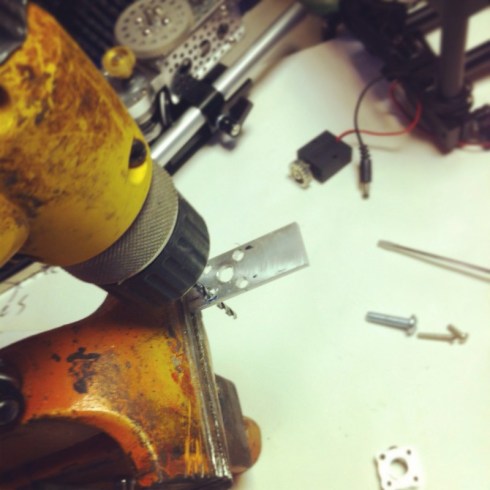
    I’ve made progress on Cambot. I drilled up some stock aluminum bars to fit between the gearing and the rail mounts so now it is all secured together. I also swapped out one of the axels for a carriage bolt so I’d have a way to tighten it down.

    So far I’ve worked out the pat/tilt mechanisms and it seems to be working pretty well. I’m driving the two DC gear motors via a Dynamic perceptions AT2 controller.

    I’m still a bit concerned about the overall weight and size. I wanted to avoid unnecessary strain on the motors, so I took the camera off the mount while testing it.

    Here it is fully assembled;
    Untitled

    Sadly immediately after this test there was a ‘pop’ noise and since then the 12v DC adapter I’ve been running this from stopped working. This was a new power supply, purchased with my AT2 and used only 4-5 times no longer than an hour each time, and and it was hooked up to a surge protector, so I’m at a loss to explain what happened to it, manufacturing error perhaps?. I have no way of testing to be sure it didn’t fry the controller or motors, I can only assume(hope) that is as far as the problem extends. I’ve got a replacement on the way …

    I keep reminding myself that I started this project to learn what goes into building something like this more than I did because I couldn’t afford a packaged system.

    Continued here;

    http://isdrab.com/2013/10/08/cambot-pt5/


    Cambot part 3

    Cambot part 3

    Continued from; Cambot pt2 (BRAIN storming)

    I’ve been thinking a lot and working on my Cambot. I try to keep the end goal in sight as I am teaching myself just enough to make this work. In the end I’m hoping to be able to set it up for both live action and StopMo, on a stage and out on location. So it needs to be somewhat modular and self-contained in the end, so not (solely)controlled by a computer.

    I’m not much of an engineer, more of a hardware-hacker and I’m basically teaching myself this as I go along, which is partly why I’m working it out in parts. I’ve also not got access to a proper machine shop, so I’ll either be at the mercy of my friends, looking into buying a mini mill, or attempting it with hand tools.

    But first some inspiration from Vimeo user Displacment1, who has some really amazingDragon Stop-mo MoCo rigs;

    I’m really liking these designs, modular and adjustable. As much as I like the simplicity of my Geared tripod head I think I’m going forward with this sort of a nodal pan/tilt head design.

    Mohan has made some really slick 15mm-based pan/tilt/slide rigs. He appears to be using carbon fiber 15mm rail rigs, so it’s both light-weight and strong! which he has custom built using stepper motors and custom gearing;
    Another similar 15mm pan/tilt head was found on the dynamic perception’s forum here. He says he was able to assemble the whole thing for $450, which seems low to me, especially after seeing other offerings.

    The miniengine seems to be a really cool way to run time lapse, or shoot-move-shoot based moco. It seems to be well-supported and designed, and actively developed. The next version seems even better, definitely something to keep an eye on…

    BFG motion control seems like a great system. They provide a hardware encoding box and GUI interface for designing complex shots. However their price of $1000, which is reasonable for something of this kind, is outside my budget for this project. I’m really hoping to put the whole thing together for 1k, and there is a lot of hardware to put together…

    Cambot Plan

    I’m getting close, my research and brainstorming seem to have brought me to a clear path. Well I say one path, but its more like a three phase plan.

        -Realtime mode
        -Playback mode
      -Program mode

    Realtime mode – Hardware rig

    The first step is assembling the rig, the real hardware of it. That will show me the physical limitations of the rig; size, weight, as well as the number and positions of axis.

    This is where I am now, essentially a manual stopmotion rig;

    IMG_1196

    cambot’s geared pan/tilt head

    Bogen geared pan/tilt head, mounted to Jib(rigged to raise and lower with an automotive jack), on machinist’s rotary table and linear slide. Current arrangement is set up for manual moments. Turning the wheels incrementally of the geared head and cross slide allow for an animate-able camera.

    cambot’s cross slide x/y axis

    Pros/Cons; It works… mostly. It is limited to either stop motion animation for camera moves, which takes a lot of patience and focus for long, smooth camera moves. To move increments as well as animating the puppet or prop actually in the scene, or for an actor I can release the jack and move the jib smoothly, for hand-operated movements but its a bit wobbly, and requires an operator.

    On to the next phase!

    Playback/Live mode

    The next phase involves motorizing it all. I’ve got the motions plotted out, but it needs to drive itself, So I’m beginning to add gears and motors now. The goal is to rig it so that it can be remotely operated. (with speed controllers). I’m looking into offset gear motors, DC motors, and gearboxes. I’m planning to work out/test 2 axis at a time in realtime, and possibly set it to record/playback once that is working.

    I’m starting off by setting up my hardware to run off an Dynamic Perceptions AT-2 controller, starting with ez-swap dc motor or a a gear motor like these or a DC motor like these.Which will get me the chance to set up all the mechanical parts of the rig properly.

    Untitled

    This real-time controlled live action remote rig gives me the ability to control and test two axis of DC motors.
    Here is my rig as it currently stands, 2 geared axis hooked up to a joystick

    From here, an idea for self-contained playback in the mean time, this servo recorder, seems like it could record up to 3min of motion for 4-axes, and with speed controllers it could control DC motors, then play back recorded motions.

    This really seems like a good place to get, since it seems like I’d be able to control pan/tilt/focus and movement, either; slide/track/jib/rotate, however it’ll be $3-400, for it and I’m still not 100% sure it’ll work reliably/repeatably… DC motors aren’t really known for their detail in movements, and while my gearing may help I just don’t know, really people tend to use other types of motor for this sort of design, i.e. steppers or servos.

    Program mode MoCoBus Rig; stepper motors, nanoMoCo, upgrade device…

    Once the mechanical parts are working for live playback, I’ll be looking into swapping the DC motors for steppers driven by a computer, or potentially some portable brain. Ideally I’d have a magic box which allowed me to move the rig however I wanted, then have it repeat the move and export a 3d camera move which could be imported into effects software.

    This post from Dynamic Perceptions got me very excited. There are plans to take the AT2 and use it to communicate with record-able repeatable systems. Naturally it wouldn’t work with DC motors.

    If I rig my mover with stepper motors, like these Phidgets or NEMA-17,
    or  another stepper, I’d expect I need some sort of driver card for each them. I’d need something like the easydriver. I don’t really know a lot about steppers, yet. But I’ll learn.

    NEMA-17 stepper

    Currently I’ve got my sights set on Dynamic Perception’s MoCoBus, driving the stepper motors via their nanoMoCo cards. The whole system chain (MoCoBus) will feed into a computer, (potentially a netbook) for movement recording/edit/playback, StopMo, etc. (Software Workflow)The upgrade device will also allow me to drive the steppers and record the AT2 joystick’s movements into the MoCoBus chain.

    Then when the upgrade becomes available I can upgrade my whole system to use MoCoBus. Then I would need to swap the DC or gear motors out for steppers to use the nanomoco on,

    Itd be great if I could rig all my motors with nanomocos as drivers, control 2-axes of them analog for now. Once its all working smoothly, I’d plan to delve into chaining all the axes via mocobus and get more complicated multi axis moves through Graffik on the computer. And hopefully by that point I’d have access to the adapter and this updated workflow.

    Continued here;  Cambot pt4


    Cambot BRAIN storming pt2

    Cambot BRAIN storming pt2

    Continued from: http://isdrab.com/2012/03/02/cambot-and-motion-control/

    I’ve been talking with Chris Hassell from Co-Optic productions/TaskForce3D about my ideas for home-made Motion Control Rigs so I felt like it was time to update my notes on the project.

    To begin what are the goals of this project?

        Inexpensive (as much as I’d love to get a MrMoCo rig I just can’t)
        Wide range of movement
        Programmable; Move-shoot-move, Play-back and Real-time controls
        Self-contained Modular/lightweight/portable
      DIY

    Inexpensive
    I hesitate to put a number down because it’d be laughable and embarrassing, but suffice to say I have very little budget, so I’m looking for the best solution for the least cash.

    ProAim $475
    When you look for cheap video gear on ebay you’re sure to find Proaim. Its not all bad, it works until it doesn’t. They offer some motorized tilt/pan heads, realtime only control, so I’d need a remote operator, or I’d still need to buy/make a ‘brain’ for it.

    So, it may be great for long crane shots, but for this project its just too expensive…

    Wide range of movement
    How many axes of motion?
    Ideally six; Dolly (back/forward left/right), Pan, Tilt, Jib/Crane, Jib/rotate

    Yes. I want it all. I need to try and keep myself in scope for this project. My current Cambot has 7 axes of motion and may be just a bit too complicated for a programmable version; Dolly forward, incremental forward, incremental track to side, crane up, jib rotate, pan, tilt

    There seem to be a few schools of thought surrounding this, there are the hobby-type time lapse/video; pan/tilt units, pan/tilt slider, and then there are the ‘pro’ solutions which can drive more channels but frequently connect to a computer; Ditogear evolution, MrMoco, etc. These can become monster rigs, and definitely not as portable, but can be capable of any possible moment.
    For example MrMoCo’s Animoko;

    C-MOCO
    C-MOCO is a german developed motion control system based on an industrial robotics arm.

    It features a record and playback model for repeated motions along 7 axis, as well as embedding camera tracking data into R3D files for use in 3D and compositing applications. This is exactly what I want, but the fact that there is no price on their website tells me ‘if you have to ask, you can’t afford it.’

    It seems like the biggest limitation for this is the ‘brain’; how many channels can I simultaneously control?


    Programmable;

    Looking at “brains” to control a MoCo rig, so far these have looked like the best options;

    Konova
    Basic Motion Controller Bundle $480
    This is a kit for converting a slider into a MOCo unit. It only controls a single axis and is primarily intended for time-lapse. Like many, its max speed is controlled be swapping motors into place, using the gearing of the motor to speed it up or slow it down.

    They also offer the SMART controller. $706

    This offers the same single axis, but also allows for more control, live mode, ramping of speed, stop-motion, limit switches, etc.

    MX2
    Timelapse Camera Slider Motion Controller $225

    This is the brain behind many time lapse rigs, it controls a single-axis for slider movements and also can be made to hook up to a telescope head for pan/tilt movements

    Sadly there was an update done to the model of telescope head typically used, but the best ones are available from this site

    Kessler Crane
    elektraDRIVE BUNDLE PACKAGE with ORACLE Controller $1,314.95 $1k(controller only)
    http://www.kesslercrane.com/product-p/100132.htm

    This can control two axis, so either a slider or a P/T head. It appears to be set up for very complicated programming, ramping motions, real-time/timelapse/stop motion, all that you’d expect.

    Ditogear evolution $976.47


    http://ditogear.com/store/80-evolution-motion-control-interface.html
    Ditogear really has an exciting product here. With up to 6-axis control, bezier controls for the ramping and motions, wifi enabled. It runs on android devices, with an IOS version expected in 2013.

    Ditogear has also been collaborating a lot with this next one…

    Dragonframe
    Dragonframe software $295
    IOTA controller $750

    It seems there may be no option for live playback since this is a software solution primarily for stop-motion, but through their IOTA (2-axis) controller or with an arduino (up to 8-axis) you can interface with stepper motors for motion control. The interface seems really slick, with bezier ramping and many axis of potential control. Additionally, and this part is very cool to me, they have created an interface allowing for the control of DMX lighting, so that while being able to control your camera’s move you can also have animated/programmed lighting. (I’ll be writing another post about lighting later)

    eMotimo TB3 $750
    http://emotimo.com/index.php?option=com_content&view=article&id=46&Itemid=27

    Programmable for video and stop-mo, and self contained, supports Pan and Tilt plus outputs to control a third axis. It is also firmware updatable with open source architecture and a community.

    CineMoco $415/$825

    Slick, transportable and self-contained, the CineMoco dolly/slider presents a good option for a single axis of motion. It is programmable for Video/timelapse/Stopmotion. However it is $425 for the Dolly, and does not appear to have a supported way to control/program additional axis of movement. I did a bit of research though, and it sounds like they plan to allow for daisy chaining, and the developer of it says it can support up to 32 axis

    Modular/lightweight/portable
    Ideally this is something that can be easily broken down and brought on set, or out to a location to shoot background plates.

    CamBlock $10k
    The best in the ‘modularity’ category, and something I’d love to model off of is CamBlock For their brain they use a pocketPC running custom software.

    But at $10k for three axis movement its out of my league.

    DIY
    Open Moco
    This group of makers/hackers using the arduino have come up with some great open-source solutions, and appear very helpful, and many solutions have come from here, including the MX2;
    forum/resources

    John Pilgrim
    I’m sure there are a lot of people online doing similar home-made rigs, but John is one who’s designs have stood out to me;His design for a pan/tilt head using stepper motors and pre-assembled gearing is pretty inspiring

    Phidgets motors

    These motors are apparently very quiet and will fit in Dynamic perception’s mounts;

    Gini Slider $350

    This slider looks very good, especially for the price; Modular and expandable. I could definitely see hooking up a motor and belt to it very easily;

    8020

    80/20 seems like a lot of fun. Its T-slot framing, basically there are a bunch of extruded aluminum parts made to interlock, and designed essentially like an ‘industrial erector set.’
    Ebay store
    8020

    Servo city
    Pan/tilt $649.99

    In addition to having a wide selection of stepper motors, DC motors and real-time controlers, servo city also offers a couple pan/tilt heads. They look very well made and sturdy, but the price is a bit high for something which would still need a ‘brain’.

    For realtime and playback they even have self-contained servo driver/controllers;

    Conclusion
    I’d hoped gathering these notes would provide me with a clear winner, but I’m still deep in the brainstorming phase. I’m tempted to start with the Gini slider to go with my current rig and piece together a modular arrangement, then work on finding a way to motorize it with Phigets and ServoCity motors, or one of the more expensive kits from ditogear or Kessler ($629).

    But deep down I realize the brain should be the starting point. The best brain sounds like it’d be an arduino-based custom one, since the majority of the open source ones appear to be that way, and there looks like some good firmware starting points at Open Moco but not being an engineer or skilled programmer I’m hesitant to try and do that part my self. As far as prefabricated, the best ones seem to be the dito gear evolution with its nearly $1000 price tag, the more affordable Cine Moco, which would be great and self contained, but most useful if I can confirm that it’ll support more than one axis of motion, or the eMotimo with it’s three axes and integrated pan/tilt, but I’m a little discouraged by the the non-nodal pan and need to separate the camera from the current rig.

    Continued here; http://isdrab.com/2013/04/13/cambot_pt3/